This study investigates whether low self-control theory explains self-reported criminal activity in late adulthood. Cross-sectional survey data from telephone interviews conducted with individuals aged 60 years and older in Arizona and Florida (N = 2,000) are used.
Regression analyses show that low self-control is related to criminal offending. The relationship between low self-control and offending persists after the introduction of potential mediators (e.g., unstructured socializing, negative emotions, and familial ties) and is even observed across different stages of late adulthood (i.e., young-old, old-old, and oldest-old) characterized by declining physical and cognitive abilities.
Robustness checks using alternative measurement and modeling strategies also provide empirical support. Although strong causal inferences are limited by the nature of the data, the findings generally support the notion that low self-control theory partially explains criminal offending in late adulthood.
Via: http://ht.ly/S7tv4
By: Wolfe SE1, Reisig MD2, Holtfreter K2.
- 1University of South Carolina, Columbia, SC, USA swolfe@mailbox.sc.edu.
- 2Arizona State University, Phoenix, AZ, USA.
Below: Descriptive unemployment statistics from Study 2 (National Child Development Study). Monthly data for August 1974 through October 1981 are shown for participants at three levels of childhood self-control (low = 1 SD below the mean or lower; high = 0.83 SD above the mean or higher; medium = all others).
Below: Results from Study 1: (a) predicted probability of unemployment at each assessment wave as a function of childhood self-control and (b) predicted marginal total number of months of unemployment as a function of childhood self-control. The error bars in (b) represent 95% confidence intervals. Low self-control = score 1 standard deviation below the mean; medium self-control = mean score; high self-control = score 1 standard deviation above the mean. Trends shown are adjusted for the inclusion of gender, intelligence, and social class in the regression equation.

Below: Results from Study 1: (a) predicted probability of unemployment at each assessment wave as a function of childhood self-control and (b) predicted marginal total number of months of unemployment as a function of childhood self-control. The error bars in (b) represent 95% confidence intervals. Low self-control = score 1 standard deviation below the mean; medium self-control = mean score; high self-control = score 1 standard deviation above the mean. Trends shown are adjusted for the inclusion of gender, intelligence, and social class in the regression equation.
Below: Results from Study 2 (National Child Development Study): predicted probability of unemployment before and after the 1980 recession, for participants at three levels of childhood self-control (low = 1 SD below the mean; medium = mean; high = 0.83 SD above the mean). Error bars represent 95% confidence intervals.
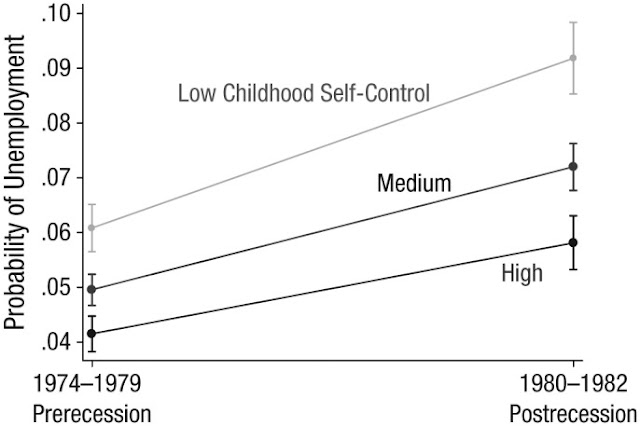
The capacity for self-control may underlie successful labor-force entry and job retention, particularly in times of economic uncertainty. Analyzing unemployment data from two nationally representative British cohorts (N = 16,780), we found that low self-control in childhood was associated with the emergence and persistence of unemployment across four decades. On average, a 1-SD increase in self-control was associated with a reduction in the probability of unemployment of 1.4 percentage points after adjustment for intelligence, social class, and gender. From labor-market entry to middle age, individuals with low self-control experienced 1.6 times as many months of unemployment as those with high self-control. Analysis of monthly unemployment data before and during the 1980s recession showed that individuals with low self-control experienced the greatest increases in unemployment during the recession. Our results underscore the critical role of self-control in shaping life-span trajectories of occupational success and in affecting how macroeconomic conditions affect unemployment levels in the population.
Read more at: http://ht.ly/RiKd2 HT https://twitter.com/StirUni


